Quirkbag Collection #45 – 24.05.26
There are 4 stages of competence when we learn anything. They are known competence, unknown competence, known incompetence, unknown incompetence. You might know them simply as “strengths” and “weaknesses”. But you may be unaware you had particular strengths or weaknesses as you don’t know what you don’t know. That’s the Dunning-Kruger effect.
So…“What Are Your Strengths and Weaknesses?”
The typical interview question aims to test someone’s self-awareness. Knowing your strengths and weaknesses is easy if you have done plenty of things or have hundreds of hobbies. But most times, the question yields boring answers like “persistent”, “disciplined”, “careful” and “perfectionism”. Most people aren’t even sure what these words mean.
These are usually what people feel about themselves based on what things they have done.
The true test of strengths and weaknesses come when we face new situations. From navigating completely new environments (like travelling alone) to learning something new (a skill or job). The complexity and uncertainty involved shows who we really are. Like waves that polish the beach, our character is only revealed when we face different waves of life.
Through these experiences, the hard-earned wisdom of how we react, behave and think comes to us. Clarity about our character and style surfaces. We now understand how “good” or “bad” we really are at learning or problem-solving. The best reference comes from benchmarking ourselves against others at a technical or professional level.
Sometimes, it forces you to admit that you aren’t as “awesome” or “competent” as you thought. Bruised ego, poor you.
Now, think again. What are your strengths and weaknesses? A story or experience should float into your mind. Not a buzzword adjective.
Another Question: ‘What are some AFIs?’
Simple. It’s the “known incompetence”. We think to improve upon what we know and observe. These can be tangible outcomes like accidents, mishaps or events or intangible observations like confusion, inefficiency or lack of communication. If you can see it, identify it, label it, you can probably fix it.
The hardest part comes when you try to fix what you don’t know is “broken”. That’s unknown incompetence. It’s like trying to find your shadow in darkness.
But you know there’s something there to tackle. You feel it. There’s an invisible obstacle impeding your progress. Like a 5 year-old in bed at night, you think there’s an imaginary monster. Ever hear the silence that falls upon the room when someone asks for improvements, that’s probably one reason. There’s the “imaginary monster” without a name that lurks.
That’s the Dunning-Kruger effect at work. You don’t know what is missing but there is something missing. How can you improve on something if you don’t know what you don’t know? If there is an invisible monster?
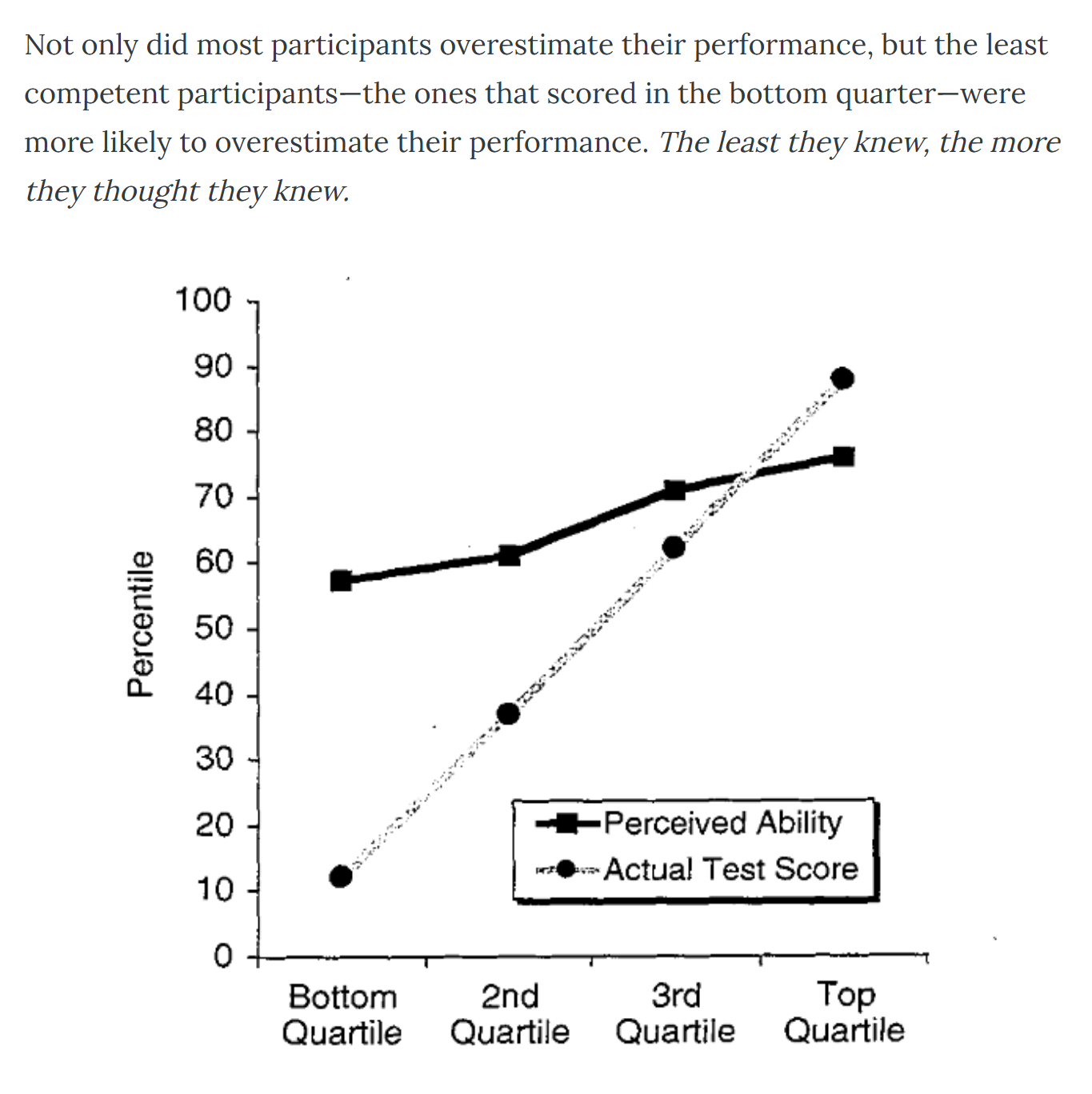
Photo From Nesslabs.com/dunning-kruger-effect
The Nesslabs article suggests meta-cognitive skills. That means enhanced self-awareness, more than what yields the boring answers to interview questions. Unknown incompetence needs you to “figure out what you don’t know”. But what if there’s nothing in mind to try?
The Pasta Method: Stumbling and Fumbling
In learning about sales, I have received advice from others that trying absolutely anything and everything is what will help you gain knowledge. I call this the “pasta method”. This is not knowledge of sales, but of yourself. It’s to find out what works for you.
Learning how you come across to others and the way you speak help to increase your circle of known incompetence. Why?
Because you get instant feedback. A forgiving smile, a light chuckle, a confused look, an angry tone. Everything is the result of a certain trigger from you. You get to know what works. You get to know where you need to work on because of the observable signs of incompetence – their lack of interest, frustration, annoyance and more.
Facing the Dunning-Kruger effect requires more than just hard work or effort. It requires smart work. Hard work is easy when the task simply needs to be done, in repetition over time. Smart work adds a layer of thinking (a very difficult thing) which determines the direction of progress. In other words, smart work before hard work. Smart work brings changes, tests, experiments.
Learning sales was easy initially because there were only so few sentences and words in the basic script. But the art of sales – holding conversations, breaking tensions and showing value – needs time and a lot of smart work. It’s easy to knock 1000 doors and say the same thing. It’s much harder to knock 1000 doors and use every door as a feedback loop to overcome the Dunning-Kruger effect.
You don’t know what you don’t know until you try something new and see yourself fail. Ask others for their feedback, actions or experiences with their learning progress.
Now, smart work requires the “pasta method”. Throw everything and anything that you have heard or thought of and see what sticks. Then, assemble the pieces to see what you didn’t know works. That’s a stumbling and fumbling step towards killing the imaginary monster. Now, repeat it again. See why it’s tough?
A Drop Of Wisdom
Stoics believed that wisdom was the mother of virtues. From wisdom came courage, temperance and justice. It’s your ability to act and to not act. Wisdom comes from experience; knowledge comes from learning. We don’t know what we don’t know because we have no knowledge or wisdom yet. It’s space that has not been explored.
In Ryan Holiday’s “Wisdom Takes Work” about the stoic virtue, it is clear that wisdom needs time, just as compounding works with time. I always tried to fast-track and compress my learning curves in everything over the months. But sales taught me that hard-won wisdom and experience cannot be “optimised” or “expedited”.
You just have to take the time. Sometimes, the long route is the short route. I have met the Dunning-Kruger effect as I learn to do sales. Everyone will at some point when they try different things for the first time. But I hope that meta-cognitive skills (aka strong self-awareness) stay in abundance in people.
That’s the only way we’ll ever slay the imaginary monster – by making it real.
Go ahead, read my other posts!
Hi! I’m Zac, the guy behind this serendipitous, quirky blog. I’m currently on a quest to find out more about myself before Uni begins – who I am and what life has to offer. This blog is my little space where I step out of my comfort zone to share my thoughts and life experiences. I hope you enjoy reading the weekly posts. Share them if you like, or not.
Teleport home below!
Find more serendipity below!