Quirkbag Collection #26 – 09.01.26
Warren Buffett explained how young people have “potential horsepower” to become anybody they wished to be, if only they put in some effort to create the right habits and seek the right role model. “Potential horsepower” is a fascinating concept to frame life decisions, particularly as making several good decisions in the short-term can set one up for success in the long run. Buffett’s not the only one to suggest this. Alex Hormozi hints at something similar here too. As I navigate how to spend my time and build towards my future, below are 4 things (in no set order) I learned that when compounded, give wonderful returns. You too, can work to compound them over time.
#1 Compound Your Money
Let’s start with the obvious: money. Yes, money can and should be compounded for a wide variety of reasons – not the least of which is fighting inflation (that’s the insidious entity that eats away at your purchasing power over time).
Clearly, I am not a professional financial advisor and this is not dedicated financial advice. This is purely a reminder to start investing early, especially if you are in your 20s, like I am at the point of writing. The reason is simple – compound interest (that and so that if you do get rich in future, it is not when you are 75 lying in the hospital).
Now, you’re not aiming to become some investment superstar or the next Warren Buffett. You just need some contextual knowledge on how money can be invested, especially if you have no clue how to invest. There are plenty of ways you can learn. If you still believe that you need a lot of money to invest, it’s time to open your eyes by reading a couple books or watching some videos. Here are some which I personally enjoyed (you’re welcome).
- How To Invest $1K, $10K And $1M – Ramit Sethi (Personal Finance)
- One Up On Wall Street – Peter Lynch (Stock-picking)
- Uncommon Profits Through Common Stocks – Philip Fisher (Stock-picking)
- The Essays Of Warren Buffett – Lawrence A. Cunningham (Investing Philosophy)
From experience, the last one requires basic contextual knowledge in finance, business and accounting to be fully understood. The same goes for the classic recommendation of “The Intelligent Investor” by Benjamin Graham.
My Reading Rabbit Hole
When I first began reading about investments in 2024, everything felt like a haze. I had no idea what I was reading and how I would ever apply any of it. But I fell into this rabbit hole of reading about investments after I discovered Warren Buffett’s investing philosophy and how it fit into this world. If it feels confusing at first, that’s normal. You are starting from zero. Over time, if you choose to stick with reading and learning, you would find that knowledge begins to compound and the whole picture becomes clearer.
With each book, it is like a puzzle piece being placed in the correct position one by one, and your understanding grows. There comes a moment when your new knowledge grows to such an extent that you almost see the world, and the subject, in vastly altered lenses.
What you invest in is for you to decide. While that feels like a description of the sky being blue, it is, ironically, also the best answer for you. No one should tell you how to spend or use your money, you have to learn it for yourself and choose for yourself. There are plenty of free websites and information online at your disposal. That said, not everything should be taken at face value and part of the journey is learning.
Theoretical Comparison Experiment
If you start investing with $1000 at age 20, with monthly contributions of $200 and no withdrawals, then at age 60, with an interest rate of 6% compounded annually, the total investment is worth over $800 000. You would only need patience and persistence to let time work.
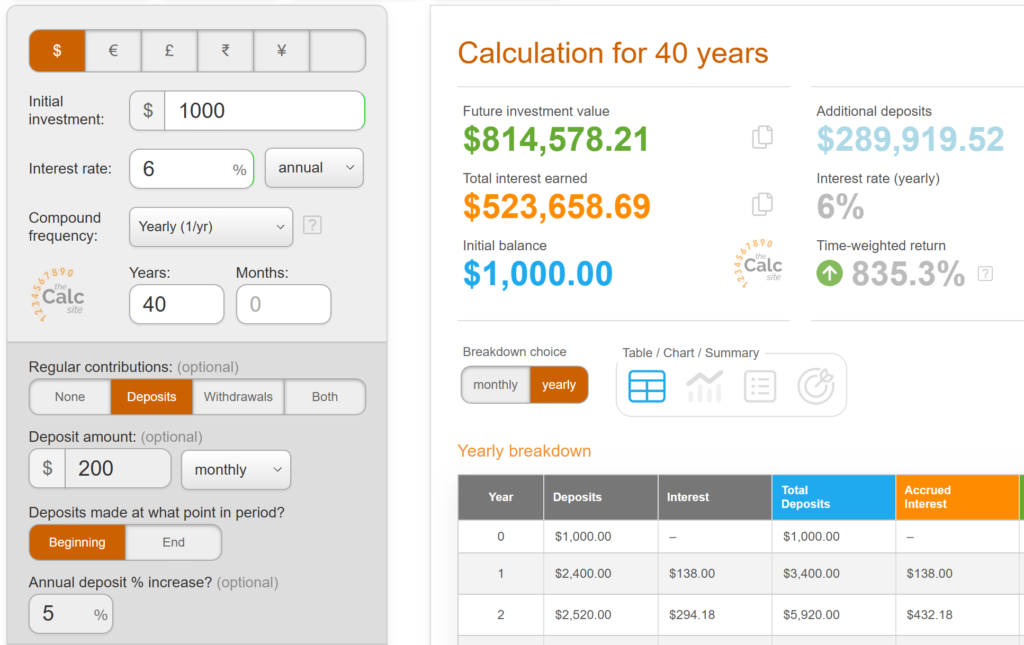
If we ran the same experiment but starting at age 30 instead of age 20 while ending at age 60, the total investment would be worth slightly less than $360 000.
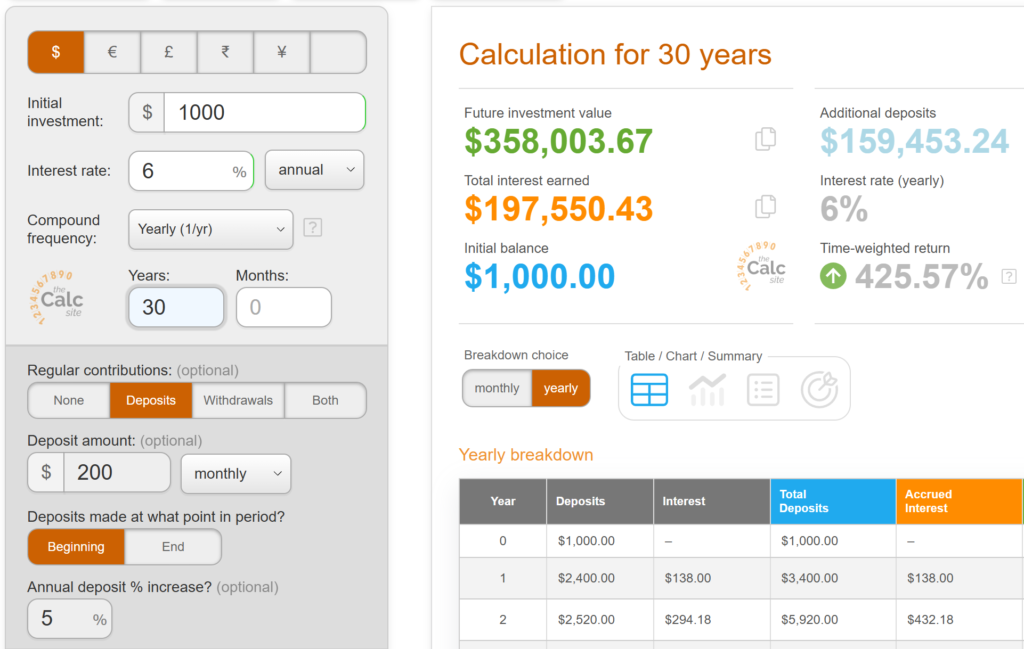
You would have more than twice the amount had you started 10 years earlier. Twice.
Therefore, START EARLY. There’s no such thing as too early with compound interest.
#2 Compound Your Health
The old saying that goes “health is wealth” can only be truly understood when some circumstance forces you to confront the fragility of the human body. The human body is quite a resilient machine, especially in youth. But it is not invincible, no matter how strong you might feel in your youth today. You could run a marathon at 30 and still need a wheelchair at 80. You could be a national youth athlete at 24 but need dialysis at 65. Age (and disease) spares no one.
Physical Health Needs Physical Activity
It’s easy to exercise when you’re like me, between the ages of 10 to 30. But the real crux lies in MAINTAINING physical activity beyond the early decades and that habit starts young. I find that exercise is less of a habit than a mindset. If you have to force yourself to exercise because you know “it’s good for you”, it will always be a tug of war. And, you risk any life disruptions knocking you off the exercise bandwagon (your reward is more guilt later on).
Conversely, to build the habit of physical activity without the friction of “ugh, I have to exercise today…again”, it probably takes a mindset shift. You have to begin to see how this physical activity adds to your life rather than a chore to complete (running on treadmills is not enticing). This is definitely easier said than done, and that’s why it’s far easier to adopt this mindset and make physical activity a core pillar of your lifestyle in your youth than later on.
If you already run for exercise, just never stop the habit. If you have no exercise at all, you can just start climbing stairs today. Then tomorrow and the day after. Then keep going. One flight, then two, next three and before you know it, you feel more energised at home.
Start compounding physical activities now, whether it’s walking, running, sports, gym sessions or others and remind yourself that it is more about maintaining this lifestyle habit over the decades than it is about performance today. Performance fades, but as you know, old habits die hard. And just maybe, with great physical health, you’ll die hard too.
If you’re curious about how Singaporeans treat their health, this is food for thought.
#3 Compound Your Skills
Primary school taught you how to do long division. Sorry, but that’s not useful anymore.
Secondary school taught you how to solve quadratic equations. I am afraid I cannot see how you might use that daily.
Junior College taught you how to find the energy needed to launch a 45kg rock into orbit. We’ll let Elon Musk take care of that.
Your degree might teach you more advanced tools, of which only several might be applied in your job, let alone last a lifetime.
All this to say, I am right there with you if you feel like you’re learning a lot of nothing. Indeed, these are very limited and even esoteric skills and tools that are not going to serve a lifetime unless you specialise in them. You might not like change, but it seems this world is obsessed with “latest new tech” and they are bound to revolutionise jobs (or eliminate them). School is supposed to prepare you for the workforce, but you cannot just rely on some fixed curriculum.
You have to begin learning for yourself, and that starts by accepting the limitations of the school system.
And that’s where I felt lost. Very lost. I had no skills and no experience for the future.
Drawing Outside The Lines
You will not learn the skill you need for your job in 20 years’ time at school. That’s very incredibly unlikely. But you might learn that you have a little grit, a touch of persistence, some discipline, a dash of curiosity and some time management skills. You might find out you have what it takes to tackle adversity. And that is enough to encourage you to start drawing outside the lines – learn new things unrelated to conventional subjects whether as a hobby, interest or even to build a side hustle.
The hard skills can be taught: accounting, sales, copywriting and more. The soft skills have to be learnt: patience, communicating clearly, listening. But, the real kicker is the skill of learning how to learn. School does not have a subject on that, because it’s impossible to grade. You have to figure that out yourself. To compound your skills, you have to figure out which other skills are worth learning.
It’s never too early to take a course online, join community classes, enrol in Skillsfuture lessons (use those credits if you have them), read some books and even watch Youtube videos. But most importantly, skills have to be practiced so start small with no stress. Practice creates permanence, permanence breeds proficiency and with proficiency comes speed.
Your focus is the future, to compound these skills over time and acquire them for future usage so take it slow. These skills will come into play later after graduation. Build your skills, start spinning the compounding flywheel.
#4 Compound Your Knowledge
Unlike one of your past history exams where you get to memorise all the “answers” and regurgitate them under timed conditions, compounding your knowledge is not at all about memorising or remembering specific information from 8 (or 80, for history students) years ago. Rather, it is about broadening perspectives and, as Gene Hackman once said, “miles and miles of heart”. It’s an abstract concept.
Compounding knowledge might not seem important in the age of Artificial Intelligence, but knowledge about people, yourself and your life is perennially essential. Ironically, you cannot learn who you are by staring in the mirror. To learn who you are, you have to try new things to put yourself in all kinds of situations – new, easy, hard, sticky, complicated and more. They test your reactions, responses, critical thinking, resilience and more importantly, clarity of mind. The more you do, the more you can learn who you are, what you are good at, and where you want to go. When you find out that your identity is not fixed, that’s when real growth begins.
Knowledge Comes With Curiosity
The best knowledge I have gained has come from random serendipitous sources in unexpected moments.
Watching Crashcourse History in high school led me to learn about John and Hank Green, whose vlog channel I watched vastly improved my English. Reading “Poor Charlie’s Almanack” at Warren Buffett’s recommendation taught me about Charlie Munger’s mental models – to draw on critical concepts from various disciplines and apply them within and beyond their domains to solve problems. Warren Buffett further ingrained in me the phrase “Price is what you pay, value is what you get”. Watching the sitcom “Seinfeld” led me to understand how it takes complete devotion to hone and polish a craft as Jerry Seinfeld did over decades.
Compounding your knowledge is less about reading than about discovering and staying curious. While curiosity is another thing that you cannot “force”, it’s something that can be evoked. It’s easy to neglect curiosity when you are a student like I was. But let curiosity linger whenever it comes. You never know what you’ll find once you tug the thread of curiosity.
Some knowledge becomes little gems in your mind and when you least expect it, it might help you in a sticky situation (like job interviews or essays)! Knowledge does not pay rent in your mental real estate; rather, it can pay dividends.
Your Best Bet? You!
At 20, I have time on my side, though the illusion is thinking it always will be. To fully leverage the benefits of compounding habits, money or anything, the earlier you start, the better. You are your own best bet! It’s easier to bet on yourself today when time and compounding effects are your advantages. Unfortunately, there is such a thing as too late when it comes to the “magic” of compounding.
I am just starting to adopt a lifestyle that leverages the benefits of compounding. Trust me when I say it always feels “off” and “slow”, especially when you first start, or even after a while. Progress feels extremely unreliable. You will question (and I did) if going to the gym is even worth it anymore, or if gaining more knowledge is useful. Your life might look different from your peers. But with the right focus on your future self, delayed gratification will be your best friend, and the habits will compound over time.
Thanks to the internet, you can choose your own “masterminds” – the people from whom you can learn and take inspiration through their content, both personally and professionally. Not simply scrolling the “For You Page” littered with meaningless brain rot content, but genuinely curating your consumption based on values and lifestyles you resonate with.
It is less about the content you consume, but more about what you learn about yourself through their content. Perhaps that is what shapes the malleable young adult mind more than anything – content that triggers thinking and a desire to grow in a certain direction.
Everyone has “potential horsepower” and the ability to compound their health, money, skills and knowledge. Just start now.
New Year, same arrows. Click them anyways!
Teleport home below!
Experience more serendipity below!